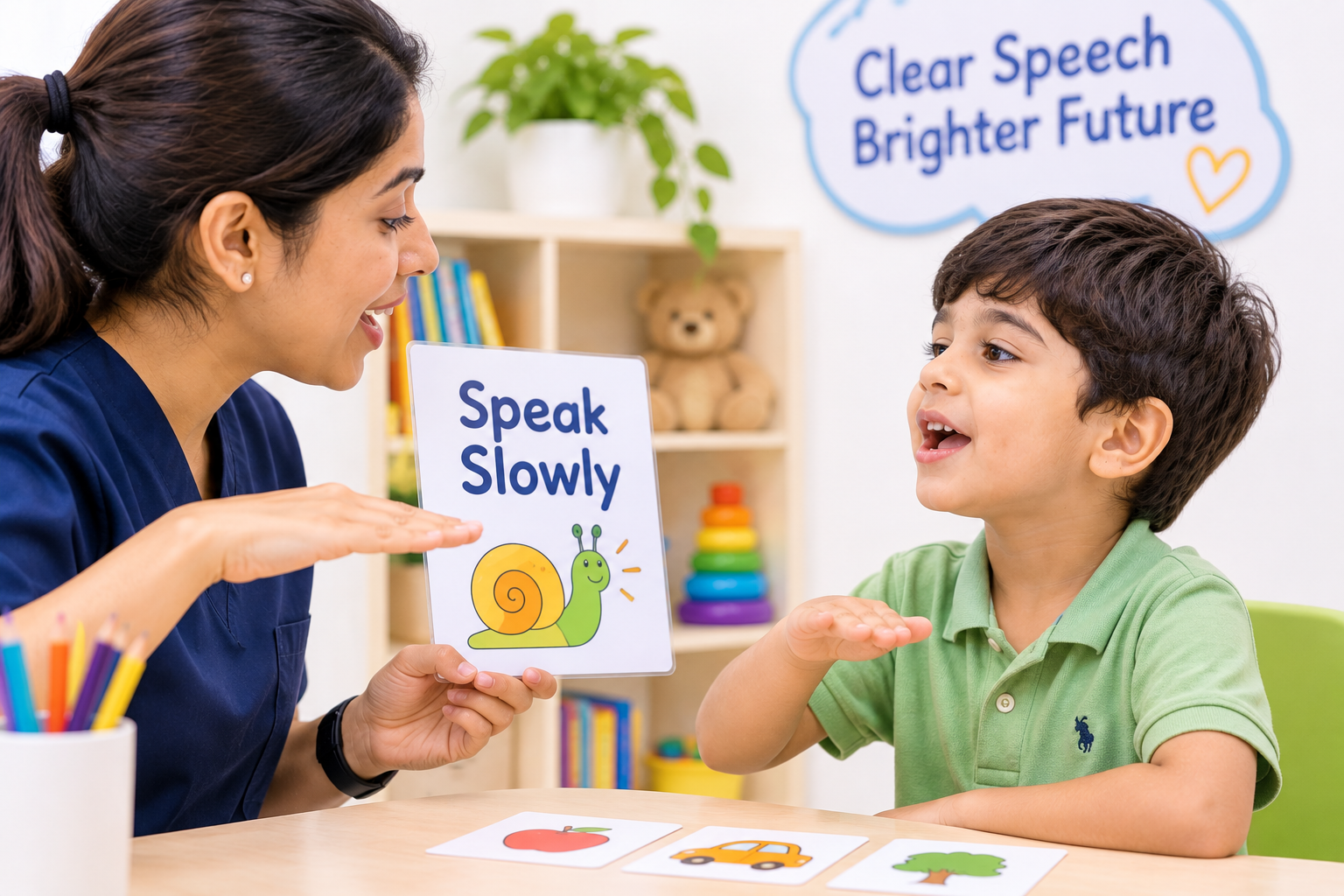
Speech Therapy Techniques to Manage Fast Rate of Speech
Understanding and Improving Speech Rate
Fast rate of speech refers to speaking at a speed that may affect the clarity and intelligibility of communication. Some children speak rapidly, resulting in reduced sound production, syllable omissions, unclear words and difficulty understanding their message.
In speech therapy, the primary goal is not simply to make an individual speak slowly but to develop a natural, controlled and intelligible speaking rate.
Speech Therapy Techniques
⇒ Rate Reduction
The therapist helps the individual become aware of their speaking rate and gradually practise speaking at a comfortable speed. This can be introduced through word, phrase, sentence and conversation-level activities.
⇒ Pacing Technique
Pacing helps individuals regulate their speech rate using external cues such as finger tapping, pacing boards or hand movements. Each word or syllable can be paired with a movement to encourage controlled speech production.
⇒ Pausing Technique
Individuals are taught to pause appropriately between words, phrases and sentences. This improves speech organisation and gives listeners sufficient time to process the message.
⇒ Syllable-Timed Speech
The individual practises producing syllables with a more regular rhythm. Clapping, tapping or visual cues can help establish appropriate syllable timing.
⇒ Continuous Phonation
This technique encourages smooth transitions between sounds and words while maintaining appropriate speech rate and natural connected speech.
⇒ Stretching Technique
The individual is encouraged to slightly prolong sounds and syllables to improve awareness of speech timing and clarity. The aim is controlled, natural speech rather than exaggerated slow speech.
⇒ Metronome-Based Practice
A metronome or rhythmic auditory cue can be used to establish a consistent speaking rhythm. The therapist gradually adjusts the cues according to the individual's needs.
⇒ Choral Reading
The individual reads aloud simultaneously with the therapist. This provides a model for appropriate speech rate, rhythm and phrasing.
⇒ Self-Monitoring
Individuals are trained to recognise when their speech becomes too rapid or unclear. They learn to independently adjust their rate and use strategies such as pausing and pacing.
⇒ Speech Recording and Feedback
Recording speech samples allows individuals to listen to their own speech, identify moments of increased rate and monitor improvements in clarity and intelligibility.
Therapy Activities
The techniques can be practised through a gradual hierarchy:
► Syllable production
► Single-word repetition
► Phrase production
► Sentence formulation
► Reading aloud
► Picture description
► Storytelling
► Structured conversation
► Spontaneous communication
Tips for Home Practice
Parents and caregivers can support speech rate management by:
♦ Modelling a natural and comfortable speaking rate.
♦ Encouraging pauses between phrases.
♦ Providing sufficient time for the child to express their thoughts.
♦ Practising short conversations and storytelling.
♦ Praising clear and intelligible communication.
♦ Avoiding constant reminders to slow down.
Fast rate of speech can occur for different reasons. In some individuals, it may be associated with cluttering, while others may demonstrate rapid speech without the features of a fluency disorder.
Assessment should consider speech rate, intelligibility, fluency, articulation, language organisation and the individual's awareness of their speech.
Treatment should be individualised according to assessment findings. The ultimate goal is to develop clear, natural, organised and intelligible communication rather than an artificially slow speaking rate.
Effective communication is not about speaking slowly; it is about speaking clearly, comfortably and confidently.
Back to Blogs